Managing contractors manually can quickly become overwhelming as your business grows. Contracts need to be drafted, signed, stored, and updated. Payments must be tracked. Invoices need approval. Compliance requirements vary across countries and states. Missing even a small legal requirement can create unnecessary risks.
This is where Deel aims to simplify the entire process.
Deel is widely known as a global hiring and workforce management platform that helps businesses hire, pay, and manage contractors and employees across multiple countries. Instead of juggling spreadsheets, email threads, contract templates, invoicing tools, and compliance documents, businesses can manage everything from a single dashboard.
Deel contractor management is designed to reduce administrative work while helping businesses stay compliant with local regulations.
In this review, we’ll look at how Deel handles contractor agreements, compliance, invoicing, payments, and support, along with where it fits best in today’s remote-first business environment.
A) What Is Deel?
Deel is a global workforce platform designed to help companies hire and manage contractors and employees internationally.
The platform combines several business functions into one system:
- Contractor management
- Contract generation
- Digital signatures
- Global payments
- Invoicing
- Compliance monitoring
- Tax documentation
- Payroll management
- Immigration support
- Insurance options
Instead of relying on multiple tools, businesses can centralize these operations inside a single platform.
For companies working with international talent, this centralized approach can save significant time while reducing compliance risks.
B) Who Is Deel Best For?
Deel is particularly useful for:
B1. Agencies :
Marketing agencies, web development agencies, design firms, and consulting businesses often work with freelancers and contractors worldwide. Deel provides a structured system to manage those relationships.
B2. Startups :
Startups frequently hire specialists on a contract basis before building full-time teams. Deel makes contractor onboarding and payment management easier.
B3. Remote-First Companies
Companies with distributed teams benefit from having a centralized platform for contracts, payments, and compliance.
B4. Businesses Hiring International Talent :
If you’re hiring developers, designers, SEO specialists, engineers, writers, virtual assistants, or consultants from different countries, Deel simplifies the legal and operational side of those relationships.
C) Why Businesses Move Away From Manual Contractor Management
Many businesses start by managing contractors through spreadsheets, email threads, PDF contracts, and manual bank transfers. This approach may work when dealing with one or two freelancers, but operational challenges start appearing as the team grows.
C1. Document Fragmentation :
A common issue is document fragmentation. Contracts are stored in one folder, invoices arrive via email, payment records sit inside accounting software, and compliance documents are scattered across multiple locations. When a contractor requests a previous agreement or a business needs to review payment history, locating the information can become surprisingly time-consuming.
C2. Visibility :
Another challenge is visibility. Business owners often struggle to answer simple questions such as:
Which contractors are currently active?
Which agreements are expiring soon?
Which invoices are pending approval?
Which payments have already been processed?
Which contractors have completed onboarding?
Without a centralized system, these answers usually require checking multiple tools and spreadsheets.
C3. Contractor Experience Matters Too
Most reviews focus on the employer side of the platform, but the contractor experience is equally important.
Freelancers and independent contractors generally prefer working with clients that have structured processes. Delayed contracts, unclear payment terms, missing invoices, and confusing onboarding procedures can create friction in professional relationships.
D) How Deel Simplifies Contractor Management
One of Deel’s biggest strengths is its contractor management workflow.
D1. Centralized Contractor Dashboard
Instead of creating contracts manually and sending documents back and forth through email, businesses can create agreements directly inside the platform. The process is organized, guided, and straightforward.

The dashboard provides access to:
- Contracts
- Transactions
- Compliance documents
- Invoices
- Tax information
- Insurance options
- Support resources
This structure helps businesses maintain visibility over all contractor-related activities.
D2. Contract Creation
Three Ways to Create Contractor Agreements in Deel : A particularly useful feature is the flexibility of contract creation. Deel offers three primary contract structures.
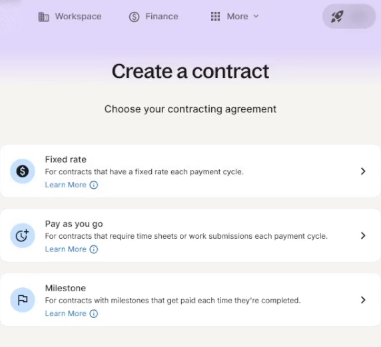
D2a) Fixed Rate Contracts
Fixed-rate contracts are ideal for recurring monthly engagements.
For example:
- Junior Designer: $2,500 per month
- SEO Specialist: $2,000 per month
- Marketing Consultant: $3,000 per month
This model works best when contractors perform ongoing work for a predictable monthly fee.
D2b) Pay-As-You-Go Contracts
This option works well for short-term assignments or hourly projects.
For example:
- Electrician support
- Technical troubleshooting
- Consulting sessions
- Maintenance services
Businesses only pay for actual work completed.
D2c) Milestone-Based Contracts
Milestone contracts are especially useful for project-based work.
For example:
Website Project:
- Homepage completed → $300
- Contact Page completed → $150
- About Page completed → $100
Payments are released as milestones are achieved.
This structure provides clarity for both parties while reducing project risks.
E) Creating a Contractor Agreement in Deel
The contract creation process is remarkably simple.
Step E1): Add Contractor Information
Businesses enter contractor details, including:
- Name
- Country
- State or region
- Role
For example:
- Contractor: James T.
- Country: United States
- State: California
- Role: SEO Outreach Specialist
Step E2) Define the Scope of Work
One useful feature is Deel’s built-in templates.
For many common roles, Deel provides pre-built work descriptions that can be customized instead of creating agreements entirely from scratch. This can significantly speed up contract creation.
Step E3) Configure Payment Terms
Businesses can select:
- Fixed rate
- Hourly
- Milestone
For example:
Milestone:
SEO Outreach Campaign
1,000 outreach emails
Budget: $600
Duration: 10 days
Step E4) Set Project Dates
Start and end dates are clearly defined within the contract.
This creates transparency and accountability for both parties.
Step E5) Review and Sign
Before sending the agreement, businesses can review all details and apply digital signatures directly within Deel.
The contractor then receives an invitation to review and sign.
The entire workflow can be completed within minutes.
Compliance Management: One of Deel’s Biggest Advantages
Compliance is often one of the most difficult aspects of hiring international contractors.
Labor laws vary significantly across:
- Countries
- States
- Provinces
- Industries
For example, contractor classifications may differ between California, Texas, New York, Canada, the UK, or Australia.
Keeping track of these requirements manually can be difficult.
Deel helps automate much of this process.
The platform can provide:
Contractor classification guidance
Mandatory compliance documentation
Standard contractor agreements
Local labor law considerations
This feature alone can help reduce legal risks for businesses hiring internationally.
F) Invoice Management and Transactions
Another area where Deel performs well is invoicing.
Businesses can create professional invoices directly within the platform.
Invoice details typically include:
Business information
Address
Contact details
Company logo
Payment information
Once configured, templates can be reused repeatedly.
This reduces repetitive administrative work.
The finance section allows businesses to:
- Track transactions
- Review payments
- Approve invoices
- Monitor payment status
- Maintain financial records
Having contracts and invoicing inside the same system creates a more streamlined workflow.
G) Customer Support Experience
Support quality can often determine whether a business platform becomes useful long term.
Deel offers several support options.
- Live Support
- Users can communicate with support representatives directly through the platform.
- AI Assistance
- The platform also provides AI-powered assistance for common questions.
H) Compliance Guidance
Users can access information related to labor laws, compliance requirements, and documentation needs. This combination of human support and automated assistance helps users resolve issues more quickly.
I) What Stands Out About Deel
After reviewing the platform, several strengths become obvious.
- Contract Creation Is Fast
- Creating agreements takes only a few minutes.
- Compliance Support Is Built In
- Many businesses struggle with international regulations.
- Deel helps simplify this process.
- Flexible Payment Structures
- Fixed-rate, hourly, and milestone-based contracts provide flexibility for different business models.
- Centralized Management
- Instead of using multiple tools, businesses can manage contracts, invoices, payments, and compliance in one place.
- Global Reach
- Businesses can work with contractors across multiple countries without creating separate systems for each region.
J) Pros and Cons
| Pros | Cons |
|---|---|
| 1. Easy contract creation | 1. Can be more advanced than needed for very small teams. |
| 2. Multiple payment models | 2. Learning curve for new users |
| 3. Built-in compliance support | 3. Premium features may increase overall cost |
| 4. Digital signatures included | 4. Deel vs Traditional Contractor Management |
| 5. Invoice management | |
| 6. Centralized dashboard | |
| 7. International contractor support | |
| 8. Helpful customer support |
Without Deel, businesses often rely on:
Word documents
Email approvals
PDF contracts
Separate invoicing tools
Accounting software
Spreadsheet tracking
This fragmented process increases the likelihood of errors. With Deel, most of these tasks are consolidated into a single workflow. This can save time while improving visibility across contractor operations.
K) Final Verdict
Deel has evolved far beyond a simple contractor payment platform. It provides a comprehensive system for managing contractor relationships from contract creation to invoicing, compliance, payments, and support.
The ability to create legally structured agreements, manage milestone payments, generate invoices, track transactions, and maintain compliance from a single dashboard makes it particularly valuable for growing businesses.
For agencies, startups, remote teams, and companies hiring international talent, Deel contractor management tool can eliminate a significant amount of administrative work.
While very small businesses with only one or two freelancers may not need all of its capabilities, organizations managing multiple contractors across regions will likely find substantial value in the platform.
If your business regularly works with independent contractors and you want a more organized way to handle contracts, payments, and compliance, Deel is certainly worth considering.