
Hiring talent across borders is lot easier now than it was a decade ago. A startup in the United States can hire developers in Poland, designers in Brazil, marketers in the United Kingdom, and customer service representatives in the Philippines in only a few weeks.
While global recruiting generates new opportunities, it also poses one of the most significant operational obstacles for founders: payroll compliance.

Many organizations focus on attracting foreign talent while underestimating the legal, tax, and reporting obligations associated with paying employes in multiple jurisdictions. Even little mistakes can lead to penalties, late payments, tax liabilities, and employe unhappiness.
This knowledge base describes what multi-country payroll compliance includes, common mistakes & practical insights to lower compliance risks while expanding globally.
The practice of paying employees while handling local taxes, benefits, deductions, reporting, and employment regulations across several nations is known as multi-country payroll. These procedures can be centralized with the use of a global payroll software.
One of the biggest mistakes is assuming that the payroll rules of the company's home country automatically apply to employees working elsewhere.
International payroll should instead consider:
1. Where the employee works
2. Whether the person is an employee or contractor
3. Which employment laws apply
4. Which taxes must be withheld
5. Which employer contributions are required
6. What benefits and statutory payments apply
7. Which currency and payment method are appropriate
8. What payroll records and filings are required
For businesses hiring internationally, establishing the correct employment and payroll structure before making payments can reduce compliance risks.
Not always. An Employer of Record (EOR) may permit a company to hire workers without creating its own local firm, depending on the hiring model and jurisdiction. Check out how this platform can help you with your efforts to hire people abroad.
Macro Level challenges
These are the problems executives care about.
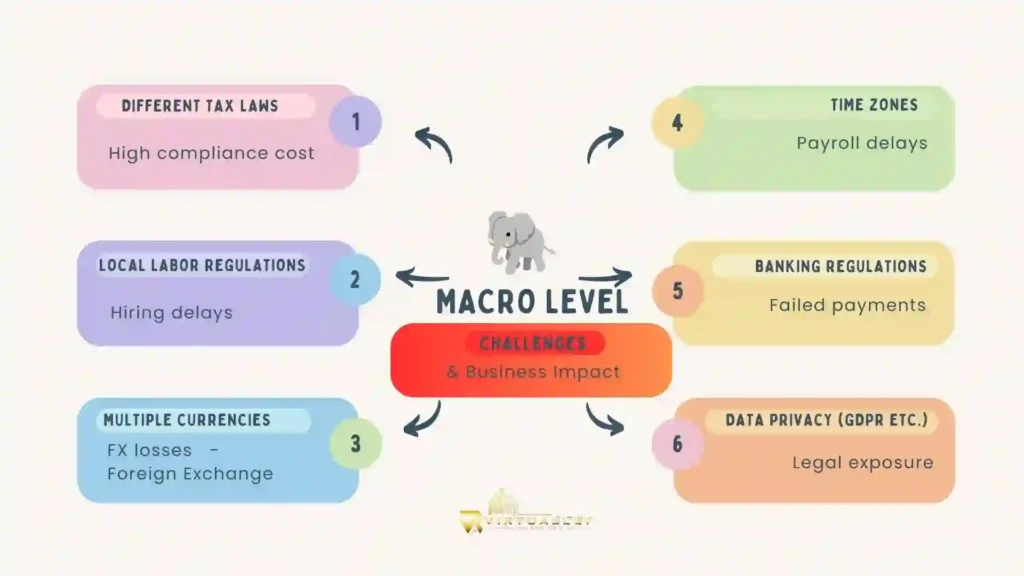
| Macro Challenges | Business Impact |
| Different tax laws | High compliance cost |
| Local labor regulations | Hiring delays |
| Multiple currencies | Foreign exchange losses |
| Time zones | Payroll delays |
| Banking regulations | Failed payments |
| Data privacy (GDPR etc.) | Legal exposure |
Micro Level challenges
These are payroll team’s day-to-day issues.
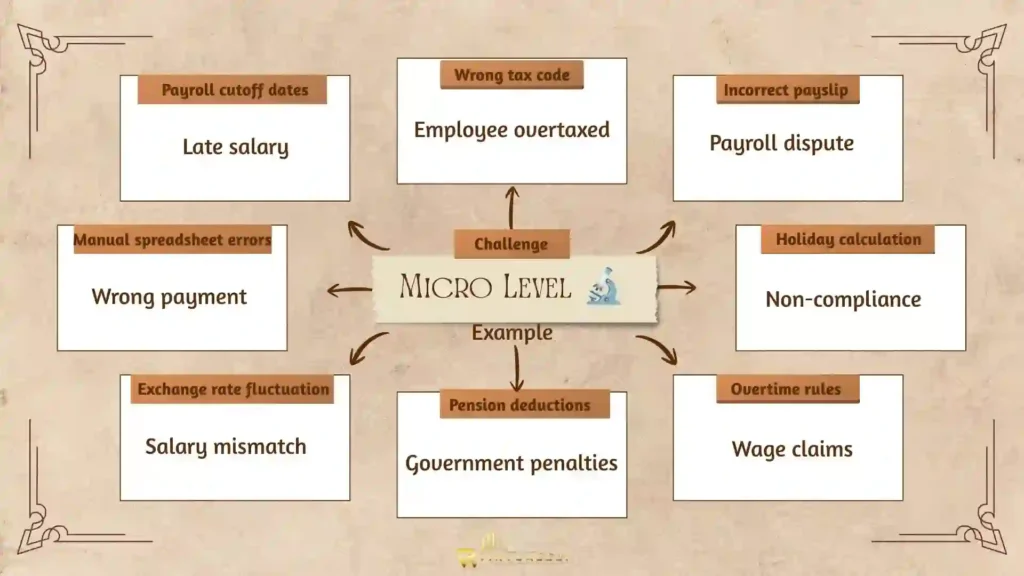
| Micro Challenges | Business Impact |
| Wrong tax code | Employee overtaxed |
| Incorrect payslip | Payroll dispute |
| Holiday calculation | Non-compliance |
| Overtime rules | Wage claims |
| Pension deductions | Government penalties |
| Exchange rate fluctuation | Salary mismatch |
| Manual spreadsheet errors | Wrong payment |
| Payroll cutoff dates | Late salary |
The taxes depend on the country and the employee's circumstances.
Depending on the jurisdiction, payroll may involve income-tax withholding, social-security or social-insurance contributions, unemployment taxes, payroll levies, and other mandatory deductions or employer contributions.
For example, U.S. payroll can involve federal income-tax withholding, Social Security, Medicare, FUTA, and applicable state or local taxes. In 2026, Social Security is 6.2% for both the employee and employer, while Medicare is 1.45% for each.
Yes.
Payroll requirements can differ significantly between countries and can also change over time.
Differences may include:
- Tax rates
- Tax thresholds
- Social-security contributions
- Employer obligations
- Minimum employment standards
- Statutory benefits
- Leave requirements
- Payroll reporting
- Payment requirements
- Worker classification rules
Businesses should therefore avoid applying one country's payroll process automatically to another country.
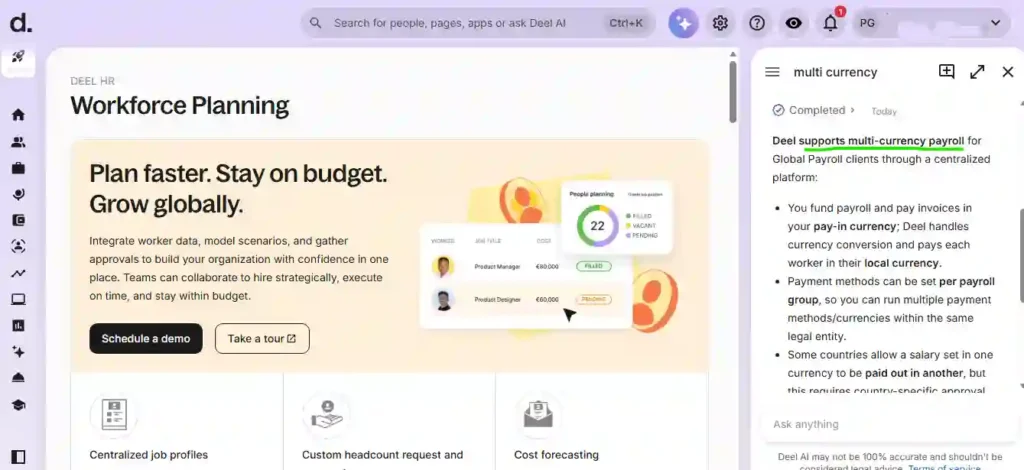
Know more about these global payroll capabilities in your target countries.
Late payroll can lead to workers disappointment, as well as regulatory or contractual concerns, depending on the country. A well-structured payroll process allows organizations to keep track of deadlines and minimize unnecessary delays.
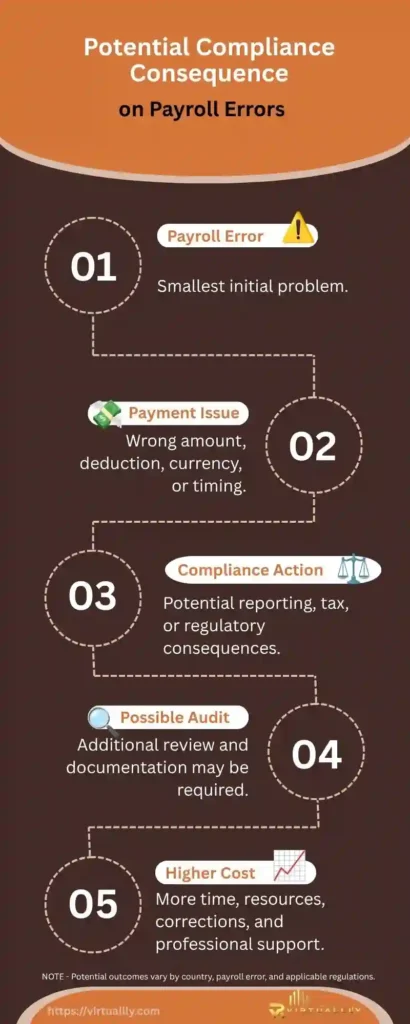
When a Payroll Error Becomes a Compliance Problem
A small payroll mistake can trigger a much larger operational burden.
Payroll Error → Payment Issue → Potential Compliance Consequence → Possible Audit → Additional Administrative Cost
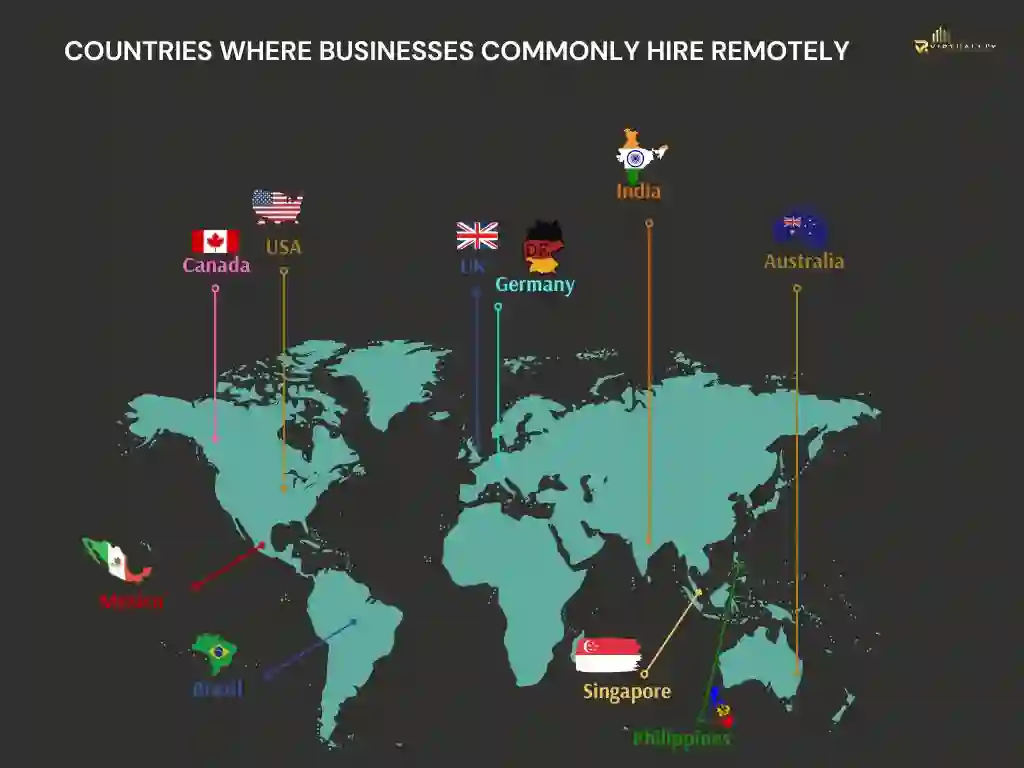
Countries
Where businesses commonly hire remotely :
Multi-Country Payroll Compliance Guide
- USA
- Canada
- UK
- Germany
- India
- Australia
- Brazil
- Mexico
- Singapore
- Philippines
IRS U.S. :
Social Security rate 6.2% for both employer and employee, Medicare - 1.45% each, and FUTA - separate employer tax.
6-Step Global Payroll Compliance Workflow
From hiring your first international employee to staying audit-ready.
- Hire & Classify:
Hire employees or contractors and prepare compliant employment contracts. - Tax & Payroll Registration:
Register with local tax and payroll authorities before onboarding employees. - Payroll Calculation:
Calculate salaries, taxes, benefits, and statutory deductions accurately.
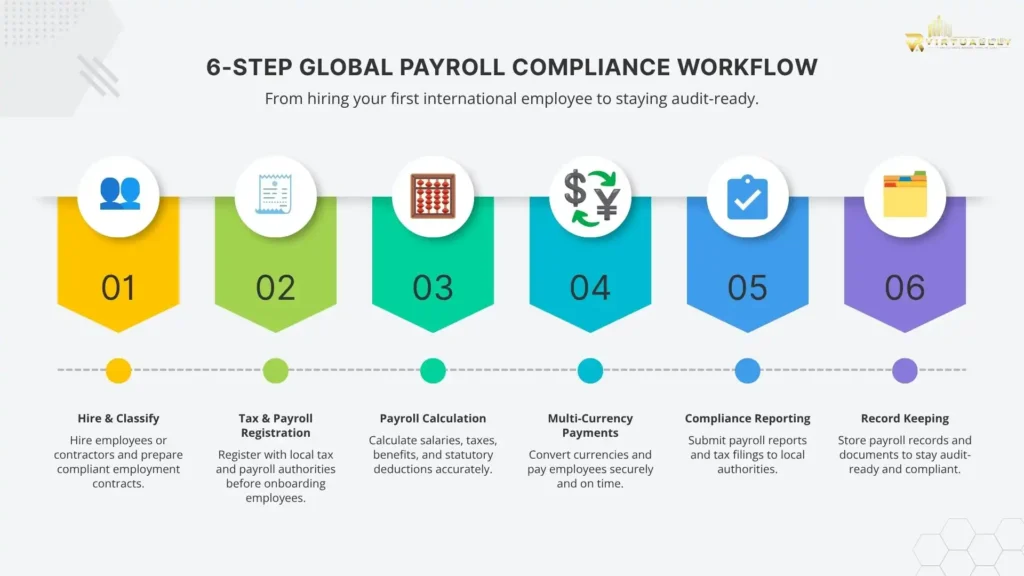
4. Multi-Currency Payments:
Convert currencies and pay employees securely and on time.
5. Compliance Reporting:
Submit payroll reports and tax filings to local authorities.
6. Record Keeping:
Store payroll records and documents to stay audit-ready and compliant.
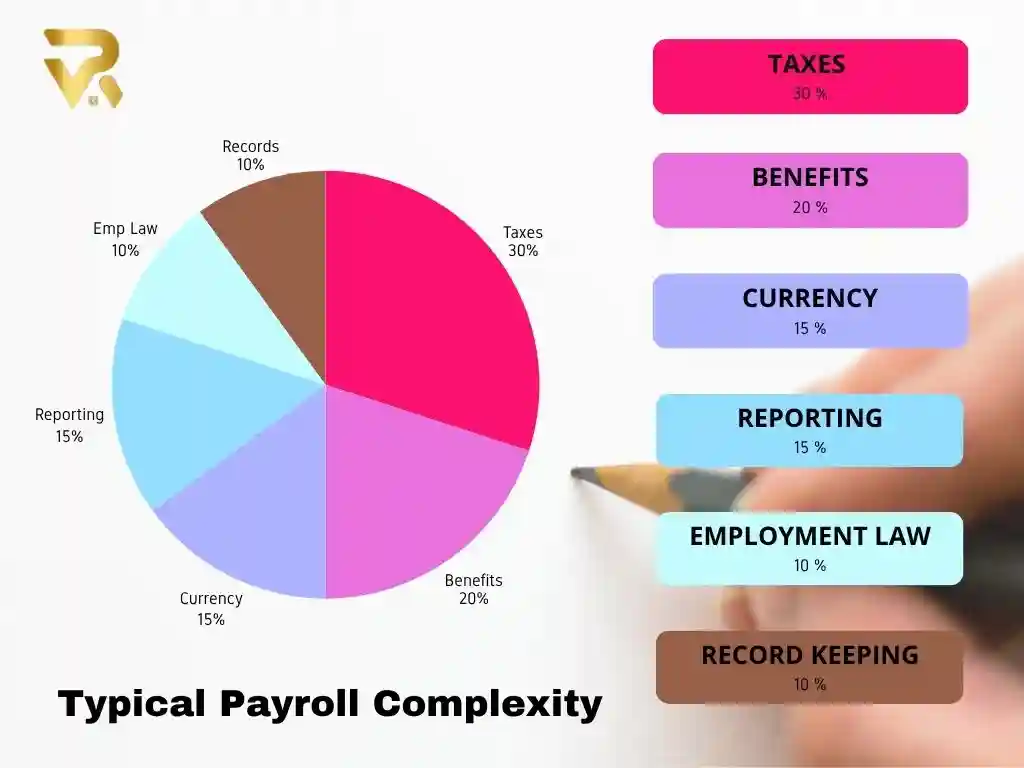
Typical Payroll Complexity
30% – Taxes
20% – Benefits
15% – Currency
15% – Reporting
10% – Employment Law
10% – Record Keeping
Currency fluctuations might affect how much a company needs to fund or how much a person receives. Companies that handle multiple currencies must account for exchange rates, conversion timing, fees, and local payment restrictions.
Records may include employment agreements, payroll computations, paychecks, tax returns, benefits, contributions, and payment details. Each jurisdiction has its own retention rules.
The world does not have a single schedule. In many nations, tax rates, minimum salaries, perks, reporting obligations, and employment regulations may altar over the time. For this reason, it's important to keep an eye on compliance.
In supported countries, an EOR can hire right talents on behalf of a business, managing several local payroll and employment duties. This can assist companies in expanding into new areas without having to set up a local organization right away. Book a free demo to talk about your hiring plans.
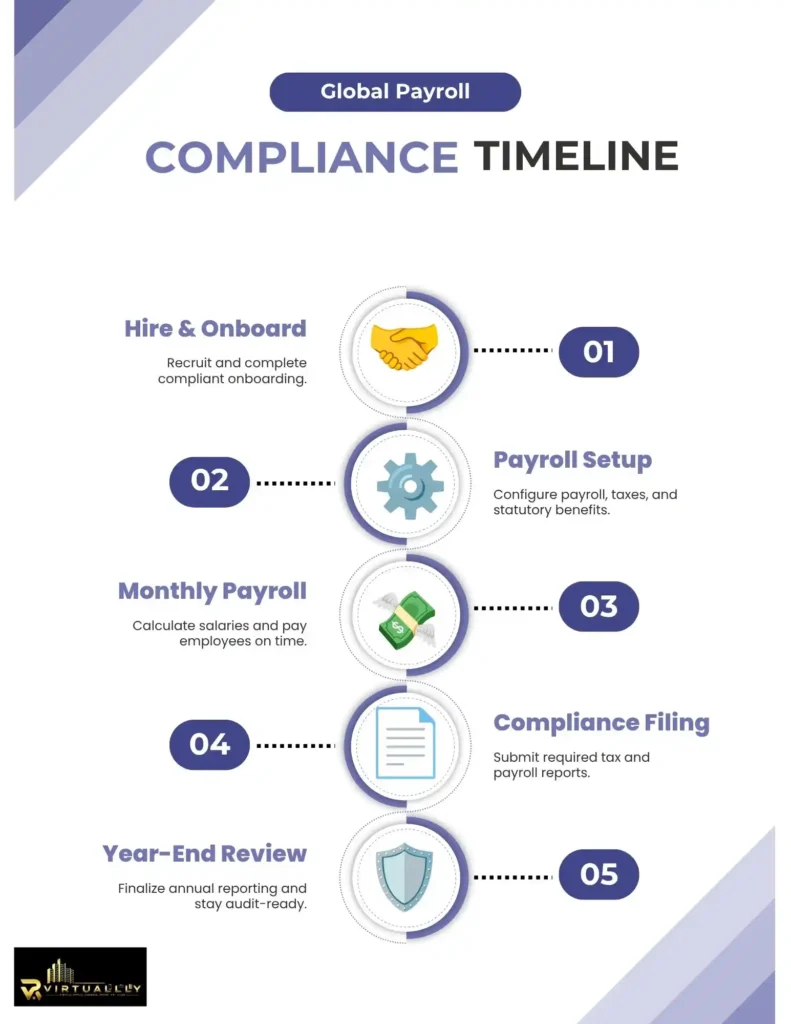
Timeline : Global Payroll Compliance
From hiring a global employee to year-end compliance.
- Hire & Onboard – Recruit and complete compliant onboarding.
- Payroll Setup – Configure payroll, taxes, and statutory benefits.
- Monthly Payroll – Calculate salaries and pay employees on time.
- Compliance Filing – Submit required tax and payroll reports.
- Year-End Review – Finalize annual reporting and stay audit-ready.
Global Payroll Compliance Checklist
Review the key requirements before processing payroll in a new country.
Requirements vary by country, worker status and employer circumstances. Use this checklist as a general guide and verify applicable local requirements.
UK PAYE
The UK uses PAYE for income tax and National Insurance, with employers responsible for payroll reporting even when a payroll provider is used.
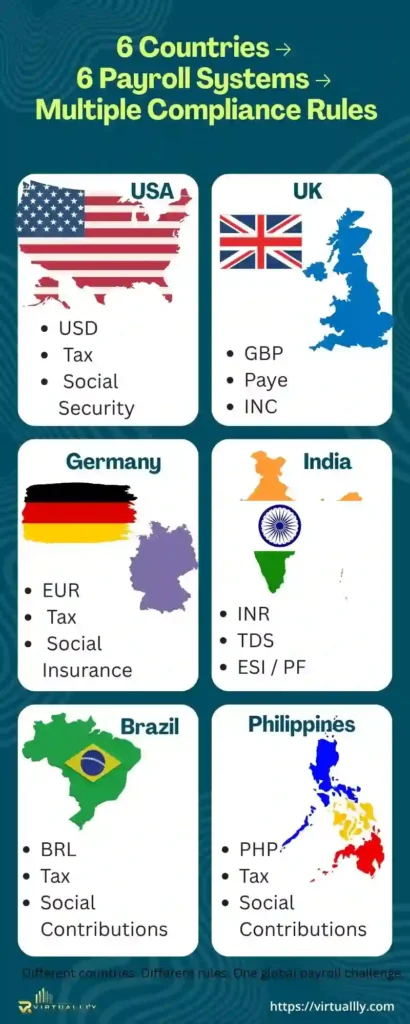
AT A Glance : Global Payroll Requirements
A quick comparison of common payroll considerations across six major hiring markets.
| Country | Payroll Tax | Social Security | 13th-Month Pay | Currency |
|---|---|---|---|---|
| 🇺🇸 USA | Federal + state/local | FICA | Generally No | USD |
| 🇬🇧 UK | PAYE | National Insurance | Generally No | GBP |
| 🇩🇪 Germany | Income tax | Social insurance | Depends on contract/industry | EUR |
| 🇮🇳 India | TDS | PF / ESI, where applicable | Depends on applicable rules | INR |
| 🇧🇷 Brazil | Income tax | Social contributions | Required | BRL |
| 🇵🇭 Philippines | Income tax | Social contributions | Required | PHP |
Important: Payroll obligations can vary based on employee status, income, location, employer circumstances, and local regulations.
IN TDS
India's current guidance also uses TDS = Tax Deducted at Source, not "tax collected at source."
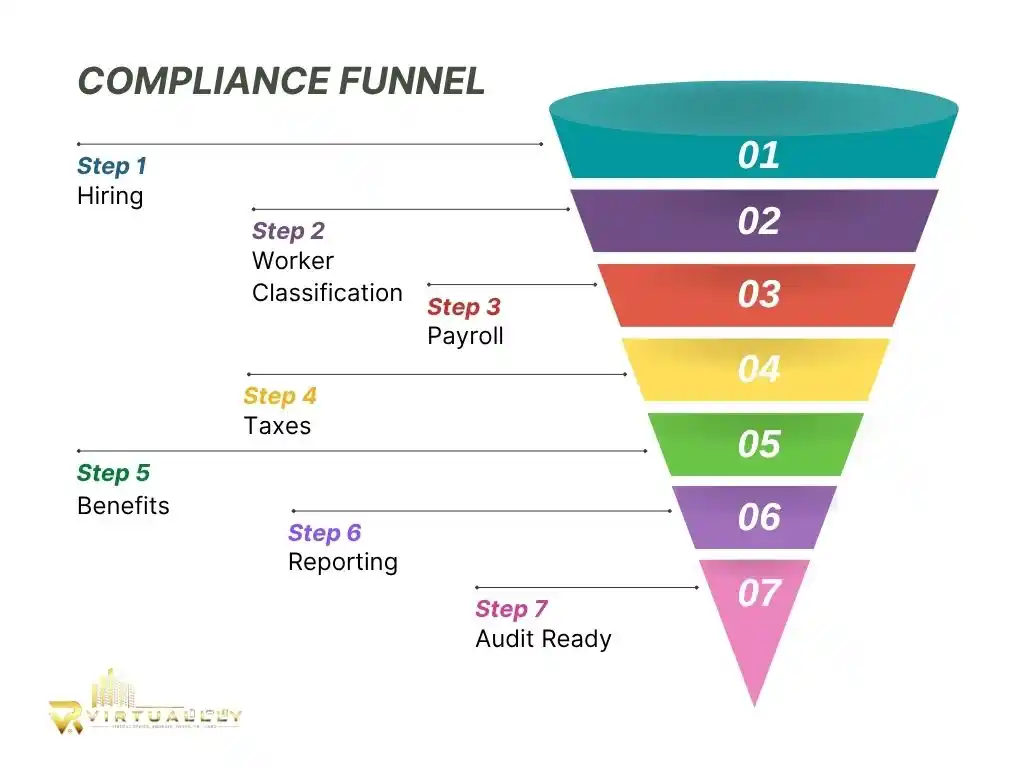
Compliance Funnel
- Hiring → Everyone starts here.
- Worker Classification → Determine whether each worker is an employee or contractor.
- Payroll → Calculate salaries correctly.
- Taxes → Meet local tax obligations.
- Benefits → Apply mandatory benefits where required.
- Reporting → File with government authorities.
- Audit Ready → The final outcome after every previous step is completed correctly.
Quick Comparison : In-house Payroll vs Deel
| In-house Payroll | Deel |
|---|---|
| Multiple local vendors | Single platform |
| Manual compliance monitoring | Compliance resources and localized workflows |
| Separate payment systems | Centralized payroll capabilities |
| Numerous spreadsheets | Unified dashboard |
| Country-by-country processes | Multi-country support |
| High administrative effort | Reduced operational overhead |
Payroll Challenges
The relative effort businesses face when managing multi-country payroll compliance.
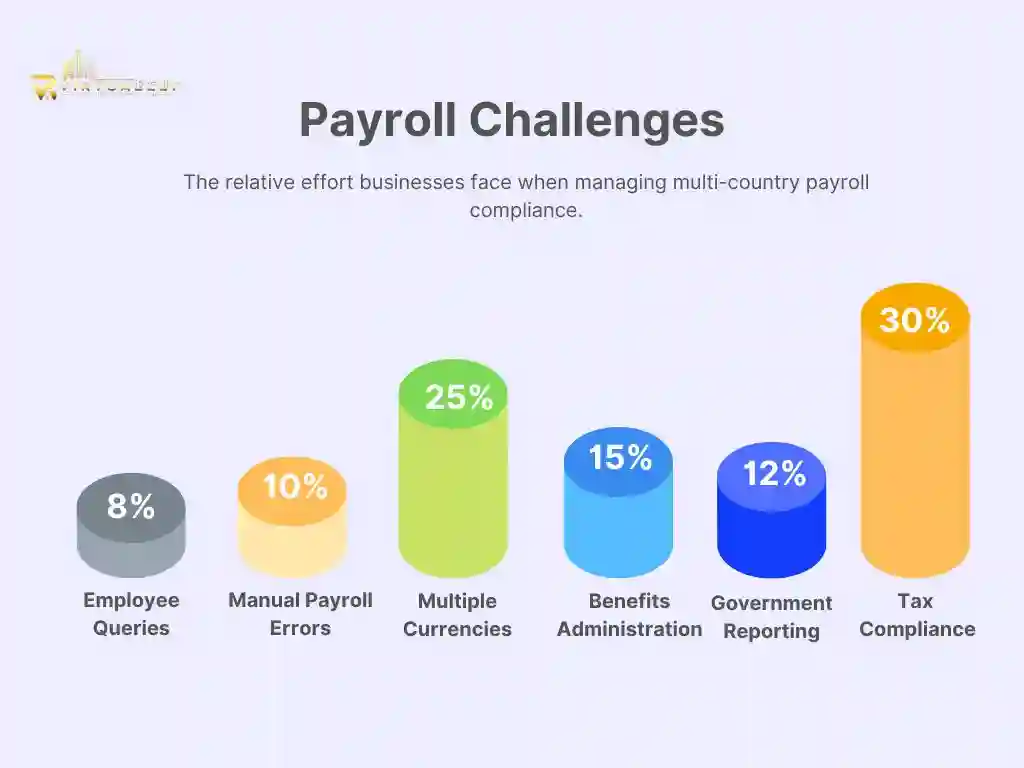
Challenge Relative – Complexity
- Tax Compliance – 30%
- Multiple Currencies – 25%
- Benefits Administration – 15%
- Government Reporting – 12%
- Manual Payroll Errors – 10%
- Employee Queries – 8%
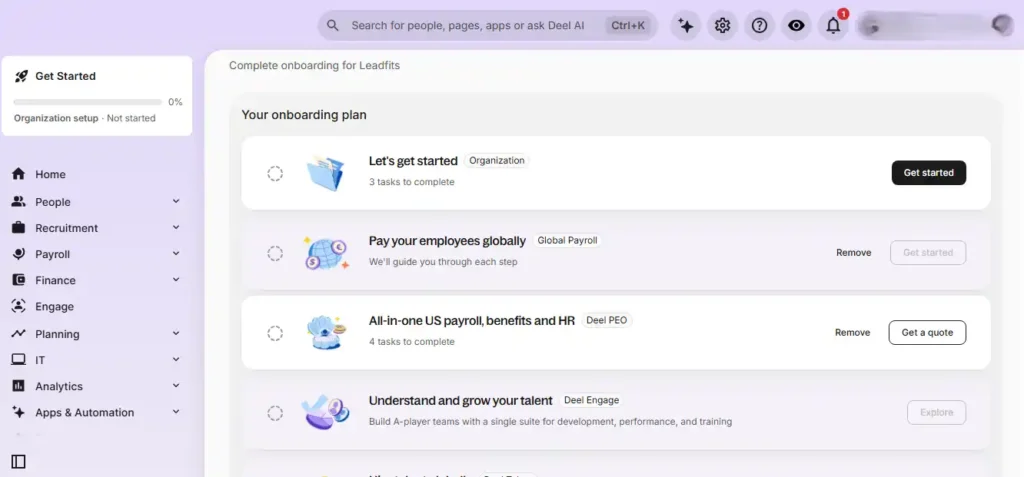
How Deel Can Help
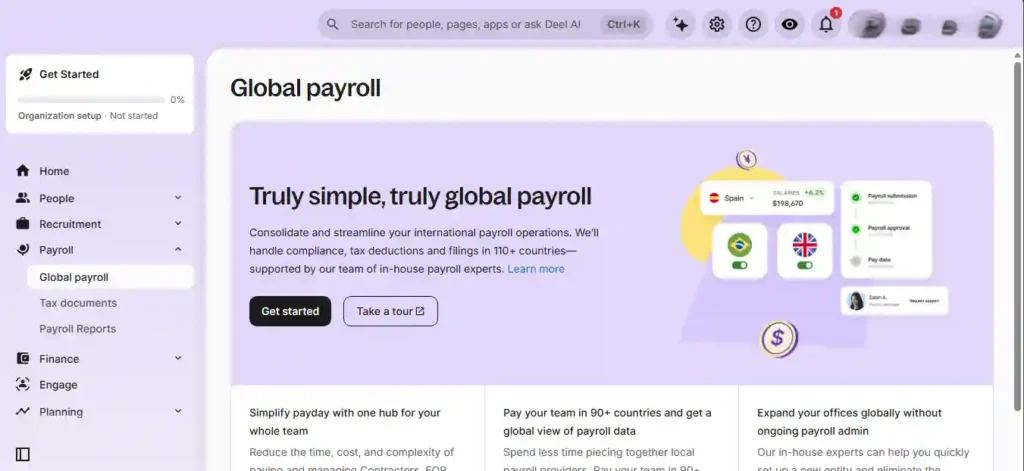
Instead of manually tracking changing payroll regulations, businesses can use Deel to simplify many administrative processes involved in international employment.
Run Global PayrollFinal Thoughts
Global hiring creates tremendous opportunities for startups and growing businesses, but international payroll compliance cannot be treated as an afterthought.
Every country introduces unique employment laws, tax requirements, reporting obligations, and statutory benefits. A scalable compliance strategy helps reduce legal risk, improve employee experience, and support sustainable international growth.
Founders who invest in compliant payroll processes early are often better positioned to expand confidently into new markets without unexpected regulatory setbacks.
Whether you manage payroll internally or work with a specialized provider such as Deel, understanding the fundamentals of multi-country payroll compliance is an essential step toward building a successful global workforce.
The right platform can streamline payroll operations, computations, employees' data, and reporting procedures while providing access to country-specific compliance resources. It doesn't remove the need to understand applicable laws.
Deel assists companies at various phases of expansion that hire foreign workers. Your country, labor composition, and payroll requirements will determine the best course of action. To find out which alternatives are best for your company, sign up or schedule a demo.
Depending on the country and product availability, Deel provides solutions for both employees and contractors. This can be helpful when a business employs a variety of workers in several marketplaces.
Start by standardizing your payroll procedure, recording regulations unique to each nation, and selecting technology that will facilitate business growth. A Deel demo can assist you in assessing your options prior to scaling if you intend to hire people from other countries.